Familiarity backfire from corrective repetition
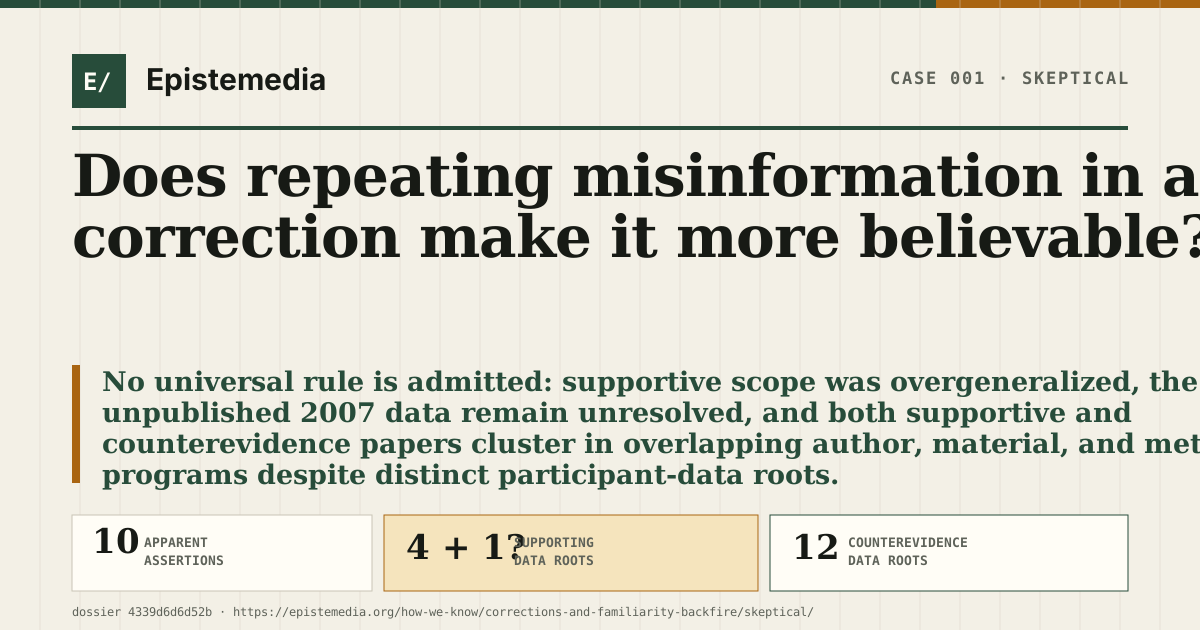
Does repeating misinformation in a correction make it more believable?
No universal rule is admitted: supportive scope was overgeneralized, the unpublished 2007 data remain unresolved, and both supportive and counterevidence papers cluster in overlapping author, material, and method programs despite distinct participant-data roots.
This exact view: Markdown · JSON · Share card
The stranger test
Many mentions, fewer evidence roots
The Stranger Test asks how many apparently separate claims still count as independent evidence after their data lineage and target fit are traced.
One participant-data lineage per publication-defined data series. Experiments within one publication are collapsed; author, method, material, and research-program overlap remain disclosed separately.
Scope:A lineage audit of the familiarity backfire claim. Independent counts refer to participant-data roots, not complete independence of authors, methods, or research programs. Worldview backfire and continued influence are distinct.
Count, opened
Every number has a list
10
Apparent support assertions
Source-side statements before data-lineage and target-fit collapse.
- Correcting the unknown: Negated corrections may increase belief in misinformation
A standalone negated correction can increase later use of a previously unseen claim when the negation lacks contextual licensing, although the exact effect did not reach significance in every experiment.
assert-autry-2021-result - Can corrections spread misinformation to new audiences? Testing for the elusive familiarity backfire effect
An unpublished 2007 study reportedly found worse myth classification and lower flu-vaccination intentions after a myths-and-facts flyer than in the relevant control conditions.
assert-ecker-2020-historical-report - The Debunking Handbook Part 2: The Familiarity Backfire Effect
Repeating misinformation inside an evidence-based correction generally makes recipients believe or rely on the misinformation more than a no-correction or pre-correction baseline.
assert-handbook-claim - When Debunking Scientific Myths Fails (and When It Does Not)
Peter and Koch reported a delayed backfire effect after journalistic myth-and-fact coverage, but all participants read the correction article and the study had no no-correction or pre-correction belief baseline.
assert-peter-koch-2016-result - Misinformation lingers in memory: Failure of three pro-vaccination strategies
Two vaccine-message studies reported delayed outcomes worse than control for myths-and-facts formats, while a later direct replication using the same materials did not reproduce the effect.
assert-pluviano-2017-result - Parents’ beliefs in misinformation about vaccines are strengthened by pro-vaccine campaigns
Two vaccine-message studies reported delayed outcomes worse than control for myths-and-facts formats, while a later direct replication using the same materials did not reproduce the effect.
assert-pluviano-2019-result - Making the Truth Stick & the Myths Fade: Lessons from Cognitive Psychology
Repeating misinformation inside an evidence-based correction generally makes recipients believe or rely on the misinformation more than a no-correction or pre-correction baseline.
assert-schwarz-claim - Can corrections spread misinformation to new audiences? Testing for the elusive familiarity backfire effect · Making the Truth Stick & the Myths Fade: Lessons from Cognitive Psychology
An unpublished 2007 study reportedly found worse myth classification and lower flu-vaccination intentions after a myths-and-facts flyer than in the relevant control conditions.
assert-schwarz-flu-result - Can corrections spread misinformation to new audiences? Testing for the elusive familiarity backfire effect · How Warnings about False Claims Become Recommendations
Skurnik et al. reported delayed misremembering of warned-against consumer claims among older adults in two experiments, but the study lacked the no-correction or pre-correction baseline required by this dossier’s target.
assert-skurnik-result - Unlicensed Corrections Violate the Gricean Maxims of Communication: Evidence for a Cognitive Mechanism Underlying Misinformation Backfire Effects
A standalone negated correction can increase later use of a previously unseen claim when the negation lacks contextual licensing, although the exact effect did not reach significance in every experiment.
assert-thomas-2024-result
4 + 1?
Target-comparable support roots
Known participant-data roots plus the lineage that cannot yet be verified.
- Correcting the unknown: Negated corrections may increase belief in misinformation
Separately reported undergraduate participant-data root. Experiment 1 found the unlicensed-negation effect; the same contrast was nonsignificant in Experiment 2. It shares Autry and a research program with Thomas 2024.
lineage-autry-2021-data - Misinformation lingers in memory: Failure of three pro-vaccination strategies
Participant-data root for the 2017 student vaccine-message study. It shares authors, a vaccine-message research program, and materials with the 2019 study and the later Ecker et al. replication.
lineage-pluviano-2017-data - Parents’ beliefs in misinformation about vaccines are strengthened by pro-vaccine campaigns
Separately reported parent participant-data root. It remains part of the same Pluviano author and vaccine-message program as the 2017 study, so program-level independence is not claimed.
lineage-pluviano-2019-data - Unlicensed Corrections Violate the Gricean Maxims of Communication: Evidence for a Cognitive Mechanism Underlying Misinformation Backfire Effects
Separately reported participant-data root testing unlicensed negated corrections with novel-word meanings. It shares Autry and a research program with Autry and Duarte 2021; program independence is not claimed.
lineage-thomas-2024-data - Can corrections spread misinformation to new audiences? Testing for the elusive familiarity backfire effect · Making the Truth Stick & the Myths Fade: Lessons from Cognitive PsychologyUnresolved
Unknown participant-data root for the unpublished Skurnik, Yoon, and Schwarz 2007 flu-flyer manuscript. Later sources describe the result, but the manuscript, data, sample record, and direct edition remain unavailable.
lineage-skurnik-2007-data
12
Counterevidence data roots
Distinct participant-data roots that rebut the universal claim under the dossier target.
- Patient Knowledge and Recall of Health Information Following Exposure to “Facts and Myths” Message Format Variations
Publication-defined participant-data root for the randomized flu-message study. Its CDC condition belongs to the historical flu-flyer family, but the participant collection is separately reported.
lineage-cameron-2013-data - Processing Style and Responsiveness to Corrective Information
Publication-defined participant-data root. Study 2 provides the target-comparable control; Study 1 lacks a true control and receives no separate target-comparable credit.
lineage-carnahan-garrett-2020-data - Can corrections spread misinformation to new audiences? Testing for the elusive familiarity backfire effect
One participant-data root for the Ecker et al. 2020 publication. Method and recruitment overlap are modeled separately so they do not collapse this paper-defined data collection into another data root.
lineage-ecker-2020-data - Correcting vaccine misinformation: A failure to replicate familiarity or fear-driven backfire effects
Separately reported UK Prolific participant-data root. It shares Ecker and Swire-Thompson, UWA ethics approval RA/4/20/6423, and a research program with Prike et al. 2023, and it directly reuses Pluviano et al. 2017 materials. Team, ethics, and material independence are not claimed.
lineage-ecker-2023-data - Reminders and Repetition of Misinformation: Helping or Hindering Its Retraction?
Publication-defined participant-data root directly comparing no retraction, retraction without a reminder, and retractions with subtle or explicit misinformation reminders. Every retraction also supplied an alternative causal account; method and research-program overlap are modeled separately.
lineage-ecker-hogan-2017-data - The effectiveness of short‐format refutational fact‐checks
Publication-defined two-experiment participant-data root. It shares Ecker and a correction research program with later papers, but no data reuse is asserted.
lineage-ecker-short-2020-data - Polarity and Attitude Effects in the Continued-Influence Paradigm
Publication-defined participant-data root. Experiment 2 directly compares an only-negated narrative with a no-misinformation control; its continued-influence paradigm is a material standalone-correction boundary. Method and research-program overlap are modeled separately.
lineage-gordon-2019-data - Familiarity backfire effects? Disentangling the competing effects of repetition and fact-checking corrections of brand misinformation
Separately reported participant-data root spanning five brand-misinformation studies and 4,337 participants. Author, sample, and method independence from the earlier paper series is not inferred merely from different authorship.
lineage-nibat-2026-data - Examining the replicability of backfire effects after standalone corrections
Separately reported participant-data root. It shares authors and a research program with Ecker et al. 2023 and shares the US MTurk/CloudResearch frame and thresholds with Ecker et al. 2020. Cross-paper participant overlap is unverified; only the paper-defined data collection is counted separately.
lineage-prike-2023-data - The Continued Influence of Implied and Explicitly Stated Misinformation in News Reports
Publication-defined participant-data root. Both experiments compare a correction in a no-explicit-misinformation control narrative with the uncorrected control; the narrative still mentioned the correction target.
lineage-rich-2016-data - The Role of Familiarity in Correcting Inaccurate Information
Publication-defined two-experiment participant-data root. It shares Ecker and Lewandowsky with other correction research but reports distinct younger and older-adult collections; program independence is not claimed.
lineage-swire-2017-data - The backfire effect after correcting misinformation is strongly associated with reliability
Publication-defined two-experiment participant-data root. Swire-Thompson also appears in other modeled papers, but the captured report describes new samples and no data-reuse dependence is asserted.
lineage-swire-thompson-2022-data
Keep the precision
Five terms, in plain language
- Apparent support assertion
- A modeled source-side statement that sounds supportive before shared lineage and target fit are evaluated.
- Participant-data root
- One declared participant dataset or publication-defined data series after known data reuse is collapsed.
- Target-comparable
- A study includes the baseline and outcome needed to test this dossier's exact backfire proposition.
- Unresolved lineage
- A reported evidence root whose underlying manuscript, data, or dependency identity cannot currently be verified.
- Policy view
- A declared way of selecting and framing relations from the same accepted dossier; it does not change the source record.
Sentence x-ray
Read the evaluated record
The visible reference names the 2005 older-adult consumer-claim study, whose design does not match the page’s flu-flyer/30-minute description.
Inspect 5 exact source spans
Source 1.1
The Debunking Handbook Part 2: The Familiarity Backfire Effect
Reference 1
"Skurnik, I., Yoon, C., Park, D., & Schwarz, N. (2005). How warnings about false claims become recommendations. Journal of Consumer Research, 31, 713-724."
Source 1.2
The Debunking Handbook Part 2: The Familiarity Backfire Effect
2011 body flu-vaccine flyer description
"To test for this backfire effect, people were shown a flyer that debunked common myths about flu vaccines."
Source 1.3
The Debunking Handbook Part 2: The Familiarity Backfire Effect
2011 body 30-minute delayed result
"However, when queried 30 minutes after reading the flyer, some people actually scored worse after reading the flyer."
Source 1.4
Can corrections spread misinformation to new audiences? Testing for the elusive familiarity backfire effect
Introduction paragraph 7, unpublished 2007 lineage
"the only clear demonstration of a familiarity backfire effect was reported in an unpublished manuscript by Skurnik, Yoon, and Schwarz (2007; discussed by Schwarz et al., 2007)"
Source 1.5
Can corrections spread misinformation to new audiences? Testing for the elusive familiarity backfire effect
Introduction paragraph 7, missing-baseline qualification
"the study also did not feature a baseline condition against which to access actual “backfire.”"
A review-level report of the unresolved flu-flyer participant data.
Inspect 4 exact source spans
Source 2.1
Making the Truth Stick & the Myths Fade: Lessons from Cognitive Psychology
PDF p. 7 / journal p. 91, flu-flyer memory sentence
"When undergraduates viewed a myths-and-facts flyer about the flu taken from the CDC website, they remembered some myths as facts after only 30 minutes."
Source 2.2
Making the Truth Stick & the Myths Fade: Lessons from Cognitive Psychology
PDF p. 7 / journal p. 91, flu-flyer intentions sentence
"Worse, their reported intentions to get vaccinated were even lower than those of control participants who had not been exposed to any message about the flu."
Source 2.3
Making the Truth Stick & the Myths Fade: Lessons from Cognitive Psychology
PDF p. 10, reference 6
"Schwarz, N., Sanna, L. J., Skurnik, I., & Yoon, C. (2007). Metacognitive experiences and the intricacies of setting people straight: Implications for debiasing and public information campaigns. Advances in Experimental Social Psychology, 39, 127–161."
Source 2.4
Can corrections spread misinformation to new audiences? Testing for the elusive familiarity backfire effect
Introduction paragraph 7, unpublished 2007 lineage
"the only clear demonstration of a familiarity backfire effect was reported in an unpublished manuscript by Skurnik, Yoon, and Schwarz (2007; discussed by Schwarz et al., 2007)"
The later study reused the 2017 materials but did not reproduce the reported backfire effect.
Inspect 2 exact source spans
Source 3.1
Correcting vaccine misinformation: A failure to replicate familiarity or fear-driven backfire effects
Abstract outcome
"We found that the myths vs. facts condition reduced vaccine misconceptions. None of the conditions increased vaccine misconceptions relative to control at either timepoint, or relative to a pre-intervention baseline; thus, no backfire effects were observed. This failure to replicate adds to the mounting evidence against familiarity backfire effects and has implications for vaccination communications and the design of debunking interventions."
Source 3.2
Correcting vaccine misinformation: A failure to replicate familiarity or fear-driven backfire effects
Method materials source
"Stimuli were taken directly from Pluviano et al. (2017) and are provided in the S1 File, available at https://osf.io/dwyma/."
Both papers used US MTurk workers through CloudResearch with the same 5000-HIT and 97% approval thresholds; cross-paper participant overlap is unreported.
Inspect 3 exact source spans
Source 4.1
Can corrections spread misinformation to new audiences? Testing for the elusive familiarity backfire effect
Experiment 1 participants
"Participants were US-based adult Amazon Mechanical Turk (MTurk) workers, who had completed at least 5000 so-called human-intelligence tasks (HITs) with 97% + approval."
Source 4.2
Can corrections spread misinformation to new audiences? Testing for the elusive familiarity backfire effect
Experiment 1 procedure administration platform
"The experiment was administered using Qualtrics survey software (Qualtrics, Provo, UT) via the CloudResearch platform (formerly TurkPrime; Litman, Robinson, & Abberbock, 2017)."
Source 4.3
Examining the replicability of backfire effects after standalone corrections
Experiment 1 participants
"To account for potential exclusions and ensure ample statistical power, 283 participants were recruited from the online testing platform Amazon Mechanical Turk (MTurk) via CloudResearch (Litman et al., 2017). Participants were eligible if they resided in the United States of America and had previously completed more than 5000 MTurk tasks (HITs) with a minimum approval rating of 97%."
The replication directly reused the 2017 stimuli, so material lineage is shared even though participant data were newly collected.
Inspect 1 exact source span
Source 5.1
Correcting vaccine misinformation: A failure to replicate familiarity or fear-driven backfire effects
Method materials source
"Stimuli were taken directly from Pluviano et al. (2017) and are provided in the S1 File, available at https://osf.io/dwyma/."
Preserves the induced-skepticism open-response result as an unresolved boundary.
Inspect 1 exact source span
Source 6.1
Examining the replicability of backfire effects after standalone corrections
Abstract results and qualification
"Across three experiments (total N = 1156) we found that standalone corrections did not backfire immediately (Experiment 1) or after a one-week delay (Experiment 2). However, there was some mixed evidence suggesting corrections may backfire when there is skepticism regarding the correction (Experiment 3). Specifically, in Experiment 3, we found the standalone correction to backfire in open-ended responses, but only when there was skepticism towards the correction. However, this did not replicate with the rating scales measure."
Kept visible
What remains unresolved
- Unresolved lineage. Unknown participant-data root for the unpublished Skurnik, Yoon, and Schwarz 2007 flu-flyer manuscript. Later sources describe the result, but the manuscript, data, sample record, and direct edition remain unavailable.
em:dossier-lineage:sha256:bcdc8f465086810c43d44ee4421818d87928b2234df8f8749f14d2d3a83d0bc3
Policy reasons
- unpublished data lineage unresolved
- team and method overlap
- measure specific qualifier
- population and context limits
Open the complete 25-work source register
- How Warnings about False Claims Become RecommendationsIan Skurnik, Carolyn Yoon, Denise C. Park, Norbert Schwarz
- The Debunking Handbook Part 2: The Familiarity Backfire EffectJohn Cook, Stephan Lewandowsky
- Making the Truth Stick & the Myths Fade: Lessons from Cognitive PsychologyNorbert Schwarz, Eryn Newman, William Leach
- When Debunking Scientific Myths Fails (and When It Does Not)Christina Peter, Thomas Koch
- A Case for Clarity in the Writing of Health StatementsElizabeth A. H. Wilson, Denise C. Park
- Rumors and Health Care Reform: Experiments in Political MisinformationAdam J. Berinsky
- Patient Knowledge and Recall of Health Information Following Exposure to “Facts and Myths” Message Format VariationsKenzie A. Cameron, Michael E. Roloff, Elisha M. Friesema, Tiffany Brown, Borko D. Jovanovic, Sara Hauber, David W. Baker
- Can corrections spread misinformation to new audiences? Testing for the elusive familiarity backfire effectUllrich K. H. Ecker, Stephan Lewandowsky, Matthew Chadwick
- The effectiveness of short‐format refutational fact‐checksUllrich K. H. Ecker, Ziggy O’Reilly, Jesse S. Reid, Ee Pin Chang
- Reminders and Repetition of Misinformation: Helping or Hindering Its Retraction?Ullrich K. H. Ecker, Joshua L. Hogan, Stephan Lewandowsky
- Reminders of Everyday Misinformation Statements Can Enhance Memory for and Beliefs in Corrections of Those Statements in the Short TermChristopher N. Wahlheim, Timothy R. Alexander, Carson D. Peske
- Recalling Fake News During Real News Corrections Can Impair or Enhance Memory Updating: The Role of Recollection-Based RetrievalPaige L. Kemp, Timothy R. Alexander, Christopher N. Wahlheim
- Fake News Reminders and Veracity Labels Differentially Benefit Memory and Belief Accuracy for News HeadlinesPaige L. Kemp, Vanessa M. Loaiza, Christopher N. Wahlheim
- Processing Style and Responsiveness to Corrective InformationDustin Carnahan, R. Kelly Garrett
- The Continued Influence of Implied and Explicitly Stated Misinformation in News ReportsPatrick R. Rich, Maria S. Zaragoza
- The Role of Familiarity in Correcting Inaccurate InformationBriony Swire, Ullrich K. H. Ecker, Stephan Lewandowsky
- Polarity and Attitude Effects in the Continued-Influence ParadigmAndrew Gordon, Ullrich K. H. Ecker, Stephan Lewandowsky
- Examining the replicability of backfire effects after standalone correctionsToby Prike, Phoebe Blackley, Briony Swire-Thompson, Ullrich K. H. Ecker
- Correcting vaccine misinformation: A failure to replicate familiarity or fear-driven backfire effectsUllrich K. H. Ecker, Caitlin X. M. Sharkey, Briony Swire-Thompson
- Correcting the unknown: Negated corrections may increase belief in misinformationKevin S. Autry, Shea E. Duarte
- Misinformation lingers in memory: Failure of three pro-vaccination strategiesSara Pluviano, Caroline Watt, Sergio Della Sala
- Parents’ beliefs in misinformation about vaccines are strengthened by pro-vaccine campaignsSara Pluviano, Caroline Watt, Giovanni Ragazzini, Sergio Della Sala
- Unlicensed Corrections Violate the Gricean Maxims of Communication: Evidence for a Cognitive Mechanism Underlying Misinformation Backfire EffectsJacob G. Thomas, Kevin S. Autry
- The backfire effect after correcting misinformation is strongly associated with reliabilityBriony Swire-Thompson, Nicholas Miklaucic, John P. Wihbey, David Lazer, Joseph DeGutis
- Familiarity backfire effects? Disentangling the competing effects of repetition and fact-checking corrections of brand misinformationIpek N. Nibat, Olivier Trendel, Robert Mai, Tinka Krüger, Wassili Lasarov, Stefan Hoffmann